What are watch jewels, and does the number on the dial matter?
Those small red dots in a mechanical movement are synthetic rubies doing a real job. Here is what they do, where they came from, and why a bigger jewel count is not a reason to pay more.
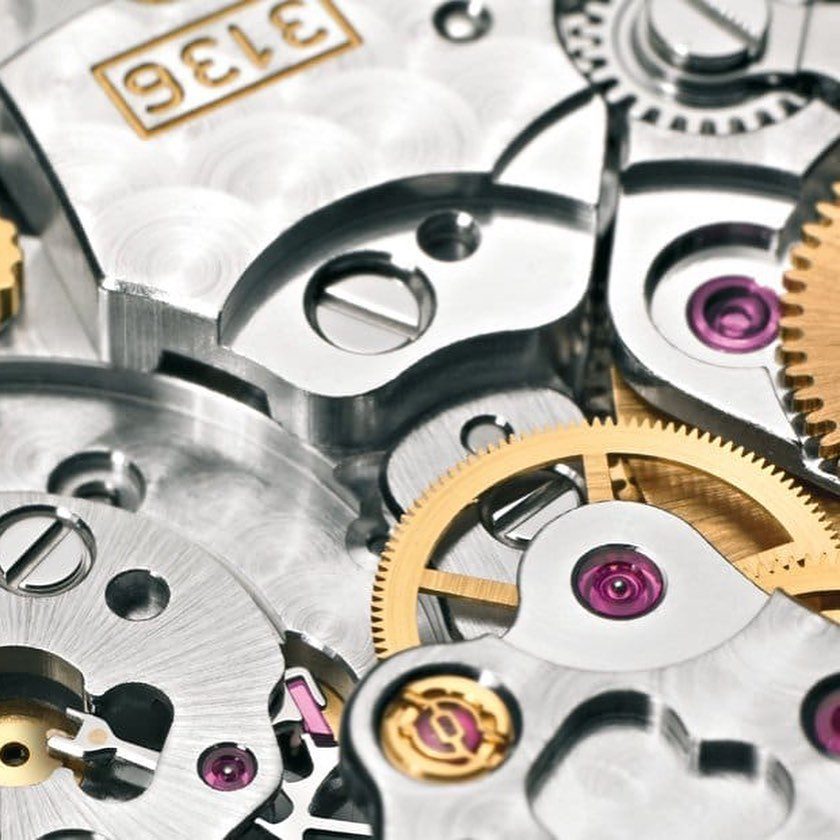
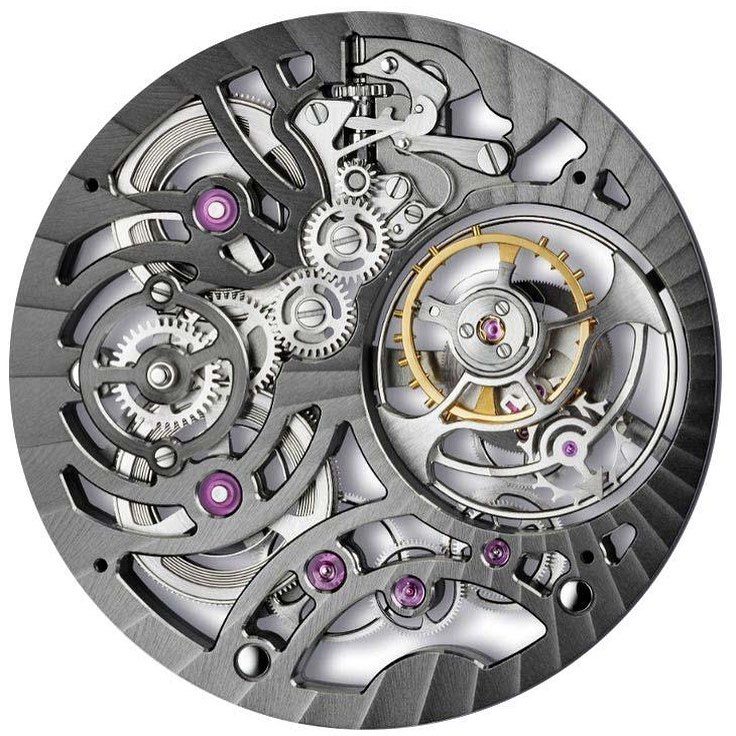
Turn over almost any mechanical watch with a display back and you will see them: small red or pink dots set into the bridges, often with a number printed somewhere, such as "17 jewels" or "25 jewels". They look precious. They are not, at least not in the way most people think. But they do an important job.
What a jewel is
A watch jewel is a tiny bearing made of corundum, the same mineral as ruby and sapphire. Today it is almost always synthetic ruby: crystalline aluminium oxide, with a trace of chromium that gives the red colour. Synthetic and natural ruby have the same hardness, 9 on the Mohs scale, just below diamond.
The jewel is drilled, polished and pressed into a hole in the plate or a bridge. A steel pivot, the thin end of a wheel's axle, turns inside it.
What jewels actually do
A movement is a chain of wheels turning on pivots. If those pivots ran directly in brass, the metal-on-metal contact would wear the holes oval over time, oil would mix with dust into an abrasive paste, and the watch would lose accuracy and eventually stop.
Polished corundum solves this. It is much harder than steel and very smooth, so friction is lower and, just as important, more consistent. One commonly cited comparison puts static friction at around 0.35 for brass on steel and 0.10 to 0.15 for sapphire on steel.
Jewels show up in a few distinct roles:
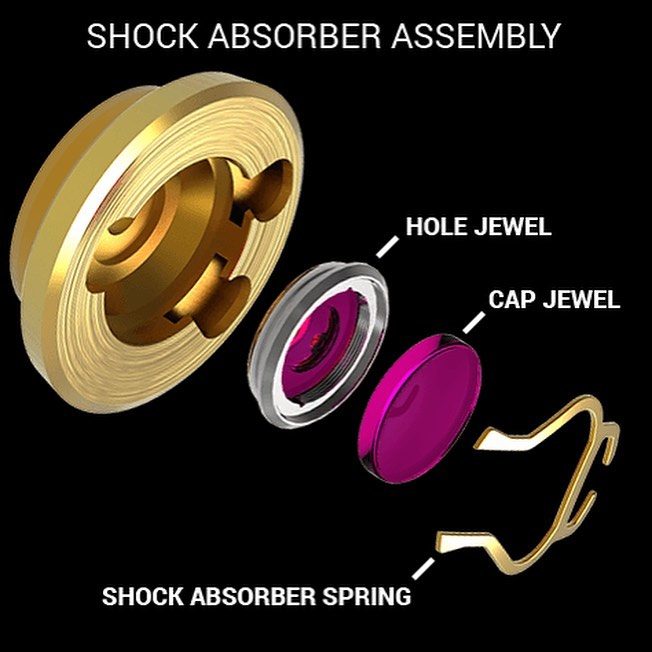
- Hole jewels for the pivots of the wheel train, the pallet fork and the balance.
- Cap jewels, flat stones that sit on top of the balance pivots so the tip of the pivot rests on a jewel too. In most modern watches they are part of the shock-protection system.
- Pallet stones, two small blocks on the pallet fork that take turns locking and releasing the escape wheel.
- The impulse jewel (or roller jewel), a small pin on the balance that receives the push from the pallet fork on every swing.
Why 17 is the magic number
A simple time-only watch is considered "fully jewelled" with 17 jewels. The usual breakdown is:
- 2 cap jewels for the balance;
- 3 for the balance itself, 2 pivot jewels and the impulse jewel;
- 4 for the pallet fork, 2 pivot jewels and 2 pallet stones;
- 2 pivot jewels each for the escape, fourth, third and centre wheels.
Add automatic winding, a date or a chronograph, and the count goes up. A current Seiko 5 Sports with the automatic 4R36 calibre lists 24 jewels, for example, and most everyday automatics sit somewhere in the twenties. Europa Star puts a simple hand-wound watch at 14 to 19 jewels.
Where they came from
Jewel bearings are an English invention. On 1 May 1704, Nicolas Fatio de Duillier, a Swiss mathematician, and the French watchmakers Peter and Jacob Debaufre were granted English patent no. 371 for a method of using drilled stones as bearings.
They then asked Parliament for an Act giving them control over stones in all clocks and watches. The Clockmakers' Company objected and produced an older watch with a stone in its balance work to show the idea was not new. The bill failed in early 1705. Even so, drilling hard stones remained a slow, specialist craft, and English makers kept their lead for a long time.
The big change came with synthetic stones. French chemist Auguste Verneuil developed the flame-fusion process for growing synthetic ruby. It was made public in 1902, although he had deposited sealed notes with the French Academy of Sciences in 1891 and 1892, and synthetic "Geneva rubies" were already sold before that. Natural stones gave way to cheap, uniform synthetic corundum.
Why jewel count is a poor guide to value
Once synthetic ruby became cheap, the jewel count stopped saying much about how much had been spent on a movement. Europa Star notes that a jewel costs only a few cents, and that most of the expense lies in drilling and setting it, not in the material. Quill & Pad goes as far as calling jewels practically worthless in economic terms.
That made the number tempting as a marketing tool, and many makers printed it on the dial. The industry eventually needed rules to tell useful stones from decorative ones: the international standard ISO 1112 is titled, plainly, "Functional and non-functional jewels". Its existence tells you that not every jewel in every watch has always been there to reduce friction.
What to look for when buying
- 17 is enough for a simple hand-wound watch. An automatic in the twenties is normal. A higher number usually reflects more functions, not better quality.
- Treat a very high count with caution, especially on older watches or unfamiliar brands. Ask what the extra jewels are for.
- Look at what matters instead: the calibre and its service history, regulation and accuracy, finishing, the availability of parts and the reputation of whoever services it.
- Jewels reduce wear, but they still need oil. A jewelled movement still needs regular servicing.
Our take
Jewels are one of the clever, unglamorous parts of a mechanical watch: cheap, hard-wearing bearings that let tiny steel pivots run for years. They deserve respect for what they do, not for what they are worth. When a dial boasts about its jewel count, read it as a description, not a price argument.
Sources
Every fact in this article comes from the sources below. Spotted a mistake? Tell us on Instagram.
- Wikipedia: Jewel bearing (opens in a new tab)
- Quill & Pad: The Number Of Jewels In A Watch Movement Indicates Value, Doesn't It? A Myth Debunked (opens in a new tab)
- Europa Star: Rubies (Watch Knowledge) (opens in a new tab)
- Antique Pocket Watch: Why Watches Have Jewels: The Patent Fight of 1704 (opens in a new tab)
- BSI Knowledge: ISO 1112:2009 Horology. Functional and non-functional jewels (opens in a new tab)
- Seiko USA: Seiko 5 Sports SRPK89 (product page) (opens in a new tab)