Cartier Santos: the aviator, the jeweller and a square watch from 1904
A square watch made for a Brazilian aviator in Paris became one of Cartier’s best-known designs. Here is who really designed it, when you could first buy one, and what the “first men’s wristwatch” label is worth.
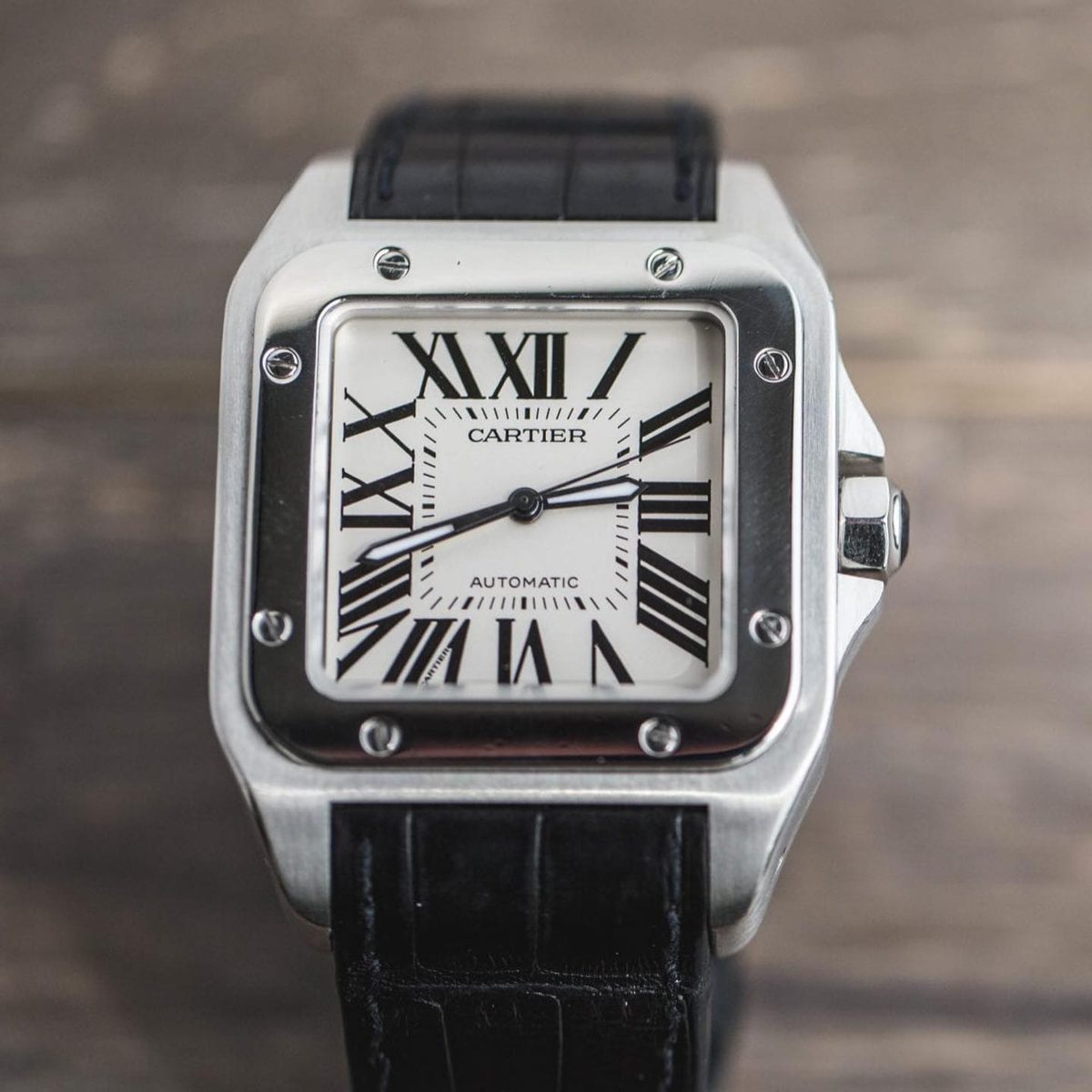
Square case, exposed screws on the bezel, Roman numerals, blued hands. The Cartier Santos is one of those watches you recognise from across a room, and its origin story is one of the best known in watchmaking.
It is also a story that gets simplified a lot. So let us separate what the sources support from what has grown around it.
Who designed it
Not the founder. Cartier was founded in Paris in 1847 by Louis-François Cartier, who lived from 1819 to 1904. The Santos is the work of his grandson, Louis Cartier (1875 to 1942), who ran the Paris house and, according to Sotheby's, was its main creative force.
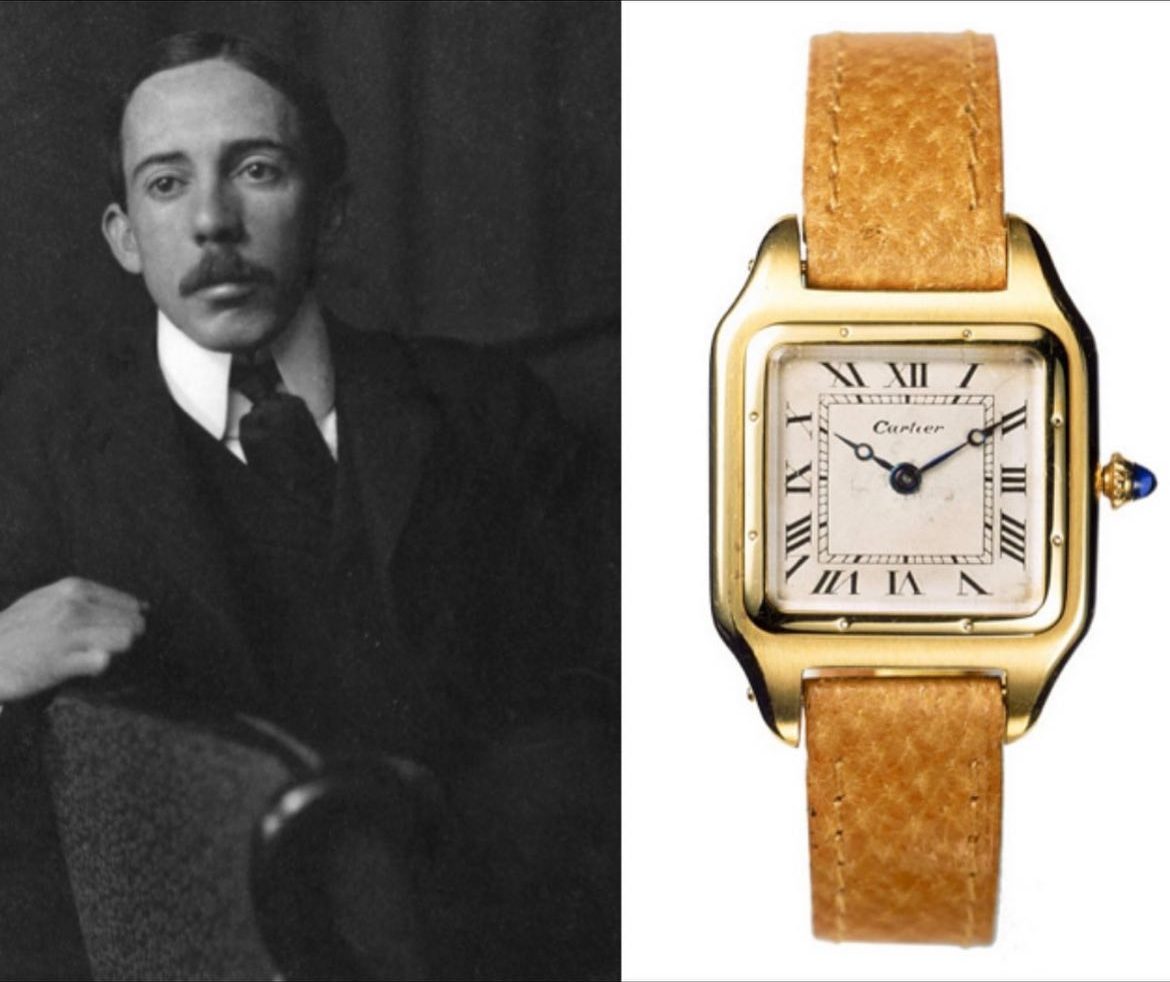
Louis Cartier was a friend of Alberto Santos-Dumont, a Brazilian aviation pioneer based in Paris. The usual account, repeated by Sotheby's, Rescapement and Quill & Pad, is simple: Santos-Dumont found that checking a pocket watch while flying was impractical, because he needed his hands on the controls. Cartier answered with a flat, square watch worn on the wrist, and the watch took the aviator's name.
You will often read more colourful versions, with a celebratory dinner and precise quotes. We could not find those details in a reputable source, so we leave them out.
1904 and 1911: two dates, both right
The watch is dated to 1904, when Louis Cartier made it for his friend. For several years it was a private piece: Quill & Pad notes that Santos-Dumont was the only person wearing the model until it went on sale.
That happened in 1911, when Cartier offered the Santos to the public. Rescapement describes the production watches as platinum or yellow gold, about 25 by 35 mm, usually on leather straps, with movements supplied by Jaeger. Quill & Pad attributes the movements more generally to the group that later became Jaeger-LeCoultre.
In between, on 12 November 1906, Santos-Dumont became, according to Quill & Pad, the first person filmed flying an aeroplane, covering 220 metres in 21.5 seconds, with what the same article suggests was this watch on his wrist.
What happened to that first watch? Gear Patrol states plainly that the exact watch Santos-Dumont wore is lost. Early production pieces survive and show the same basic design.
The “first men's wristwatch” question
The Instagram post that inspired this article called the Santos the first wristwatch for men. That claim needs care.
- It was not the first wristwatch. Breguet's archives record an order in June 1810 from Caroline Murat, Queen of Naples, for a repeater watch on a bracelet, which Breguet calls the first known wristwatch. Time+Tide also notes that men wore leather wristlets holding pocket watches in the 19th century, for example British officers on campaign.
- The men's claim is attributed, not settled. Sotheby's calls the Santos one of the world's first purpose-built wristwatches. Rescapement calls it the first mass-produced men's wristwatch. Gear Patrol sidesteps the "first wristwatch" debate and says that, either way, it was the first pilot's watch. Quill & Pad hedges even that: it may well be the first pilot's wristwatch.
The fair summary: the Santos is one of the earliest wristwatches designed for a man and sold to men, and very likely the first made for a pilot. "The first men's wristwatch" is a popular label, not an established fact.
From 1978 to today
The Santos has had several lives.
- 1978: Cartier relaunched it as the Santos de Cartier, a sportier watch in steel with gold accents and an integrated bracelet, according to Rescapement.
- 2004: the Santos 100 marked a century since the original. The large and medium models used ETA-based automatic movements. The watch at the top of this article is a steel Santos 100.
- 2018: after discontinuing the line in 2016, Cartier brought it back with a reshaped case, the in-house automatic calibre 1847 MC and a tool-free system to swap bracelet and strap. Monochrome gave the large steel model a launch price of 6,600 euros.
Today Cartier sells two families: the sporty Santos de Cartier and the slimmer, more faithful Santos-Dumont. On Cartier's US website, as shown in November 2026, the steel Santos de Cartier starts at $8,400 (medium) and $9,200 (large), and the steel Santos-Dumont starts at $4,800 with a quartz movement.
Our take
The Santos does not need the "first" label to matter. It is one of the earliest wristwatches designed for a man, built around a real problem, by a jeweller who understood that a shape can be as recognisable as a name.
If you want the history, the Santos-Dumont is the closer link to 1904. If you want one watch for every day, the Santos de Cartier, with its bracelet and quick strap changes, is the more practical choice. Either way, you are buying a design that has barely needed to change in over a century.
Sources
Every fact in this article comes from the sources below. Spotted a mistake? Tell us on Instagram.
- Sotheby's: 7 Things You Need to Know about Louis-François Cartier (opens in a new tab)
- Sotheby's: The Essential Guide to the Cartier Santos (opens in a new tab)
- Rescapement: Cartier Santos: A Brief History (opens in a new tab)
- Quill & Pad: The World's First Pilot's Watch: Cartier Santos-Dumont, 1904 to 2018 (opens in a new tab)
- Gear Patrol: The First Pilot's Watch Ever Is Also One of the Best Dress Watches Ever (opens in a new tab)
- Breguet: Order of the first watch designed to be worn on the wrist (opens in a new tab)
- Time+Tide: How did watches evolve into wristwatches? (opens in a new tab)
- Monochrome Watches: Hands-On with The 2018 Cartier Santos Large Size (opens in a new tab)
- Cartier: Santos de Cartier collection (US site) (opens in a new tab)